TimeSlipSearch
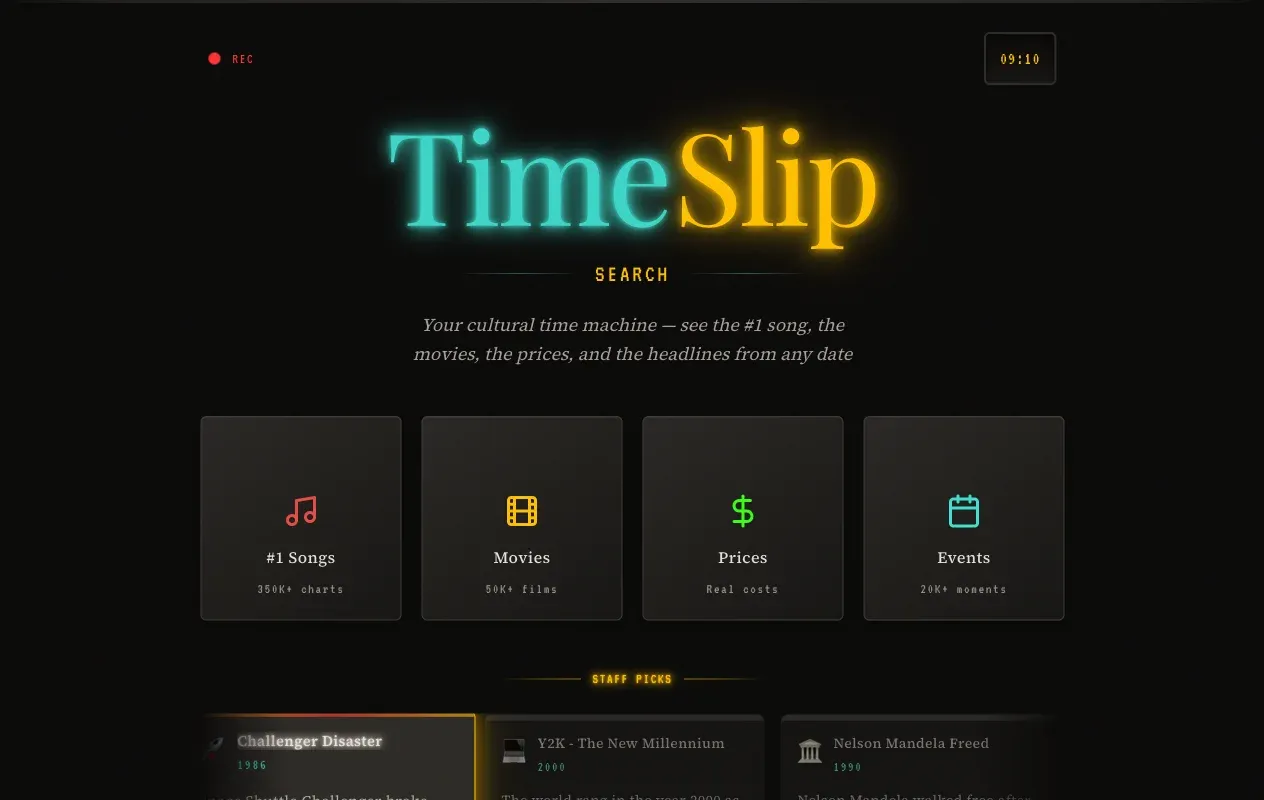
Winner of the Algolia Agent Studio Challenge in March 2026, one of four winners ($750 and a DEV++ membership). A conversational search over 420,000+ pop-culture records from 1958 to 2020: ask for "summer of 69" or a birthday and it returns the number one song, what was in theaters, what gas cost and what made the news.
- Role
- Creator
- Years
- 2026
- Status
- Live
Numbers
- Contest Prize
- $750 + DEV++
- Records Indexed
- 420K+
- Coverage
- 1958-2020
See it work
Real output, captured from the product. Open Inspect to see how it got there.
TimeSlipSearch
Algolia Agent Studio winner
Search: summer of 69
Charts
- #1In The Year 2525Zager & Evans · week of Aug 16
- #1Love Theme From Romeo & JulietHenry Mancini And His Orchestra · week of Jul 5
- #1Honky Tonk WomenThe Rolling Stones · week of Aug 30
Prices
- Gas
- $0.35/gal
- Min. wage
- $1.60/hr
- Movie ticket
- $1.44
Events
The Apollo 11 astronauts enjoy a ticker-tape parade in New York City.
The year we walked on the moon
The hard part was dates, not search
Algolia made querying hundreds of thousands of records the easy part. The hard part was turning what people type into something a search can filter on. People write “show me 1985”, “from 1970 to 1980”, “the entire 80s”, a birthday, or two dates to compare.
So every input becomes a start and an end. I strip the command words, parse what is left with chrono-node, and turn the result into a range that each of the four indices filters on. A single date is a range of one day.
The bug that taught me the most
One search for a specific date in 1988 came back empty, and the data was there. The parser attached a time of day to the date, the stored records used a different one, and the gap pushed real records outside the range.
The fix was to normalize at the boundary: every range now starts at midnight and ends at the last millisecond of its last day, before it touches a query. Since then I treat time zones as input validation, not as a detail for later.
Getting the data in
The chart data alone is about 352,000 rows. Each source has its own ingest script, uploading in batches of 1,000 so the import does not hit rate limits. When the Wikimedia endpoint changed and started returning errors, only that script changed and only that index was rebuilt.
Decisions I’d make again
- Parse every input to a range. It removes a whole class of special cases.
- One ingest script per source, so one broken upstream API never means re-importing everything.
- Explain an empty result. A date outside the data or in the future gets a “no signal” screen that says why, instead of a blank page.